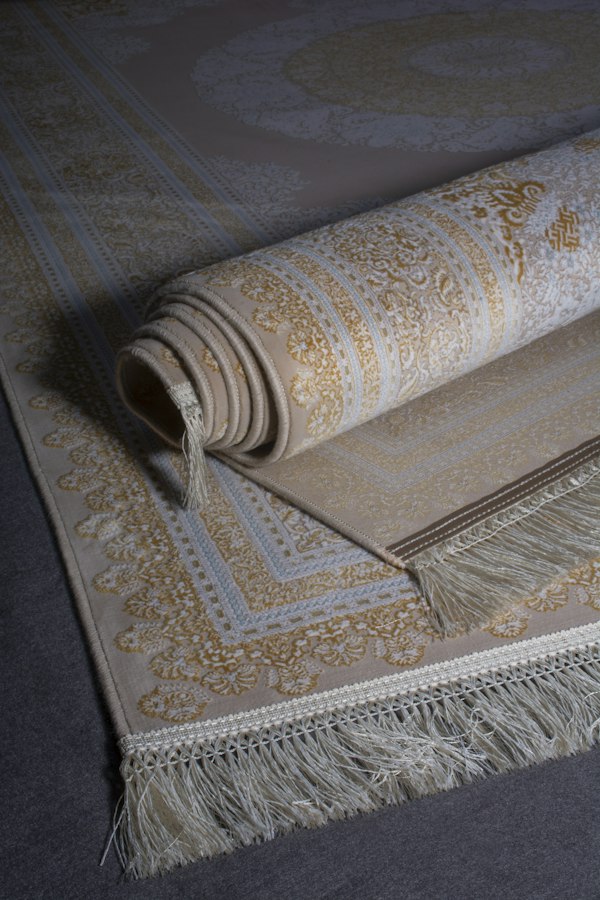
People are often scared of being scammed when purchasing luxury carpets. As a direct manufacturer in Bhadohi, India, we believe in complete transparency. Here is exactly how to verify your rug is genuinely hand-knotted.
A genuine hand-knotted rug is woven entirely by hand on a vertical loom where each knot is individually tied to the foundation, whereas a hand-tufted rug uses a gun to punch yarn through a canvas back, glued with latex. Machine-made rugs are woven by power looms in minutes. You can easily tell the difference by looking at the back of the rug: hand-knotted rugs have identical, distinct knots mirroring the front pattern, while hand-tufted rugs have a canvas backing hiding the glue, and machine-made rugs have a perfectly uniform, rigid grid.
You can verify a rug is truly hand-knotted by examining three key areas: the back, the fringe, and the flexibility. Turn the rug over; the back should perfectly mirror the front design with distinct, slightly irregular knots (no mesh or canvas backing). The fringe should be a natural extension of the foundation warp threads, not sewn or glued onto the ends. Finally, a hand-knotted rug is highly flexible and can be folded easily, whereas glued or machine-made rugs are stiff.
The back of a hand-knotted rug looks like a slightly pixelated, perfectly mirrored version of the front design. You will see thousands of individual, distinct knots. There is no canvas, no mesh, and no latex glue. The clearer and more detailed the pattern on the back, the higher the knot density (KPSI) and the better the quality.
The primary difference lies in construction technique and longevity. Hand-knotted rugs take months to weave entirely by hand, last for generations, and hold their value. Hand-tufted rugs are made quickly using a tufting gun and glue, typically lasting 10-20 years before the latex degrades. Machine-made rugs are mass-produced by power looms using synthetic fibers, offering the lowest price but zero investment value.
KPSI stands for Knots Per Square Inch, and it measures the density, detail, and durability of a hand-knotted rug. It matters because a higher KPSI (e.g., 200-400+) allows for incredibly sharp, photorealistic designs and greater structural integrity, which takes the weaver significantly longer to produce. Lower KPSI (e.g., 60-100) is standard for geometric, thicker tribal rugs. It is a direct indicator of the labor involved and the ultimate value of the carpet.
Hand-knotted rugs have fringe that is organically woven in; it is the actual structural foundation (the warp threads) extending past the pile. Machine-made and hand-tufted rugs often have fringe artificially sewn or glued onto the ends purely for aesthetic reasons to mimic the look of a handmade rug. If you see a thick binding stitching attaching the fringe, the rug is not genuinely hand-knotted.
No, 'hand-loomed' and 'handcrafted' are not the same as hand-knotted. Hand-loomed rugs are made quickly on a manual loom without tying individual knots, often lacking intricate patterns and durability. 'Handcrafted' is a vague marketing term used to disguise tufted or loomed rugs. Only 'hand-knotted' guarantees the arduous, centuries-old process of individually tying knots to a warp foundation.
A single hand-knotted rug takes anywhere from 4 to 14 months to complete, depending on its size and knot density. A standard 9x12 foot wool rug with a medium density requires three to four artisans sitting side-by-side at a loom, working full-time for six months to tie the millions of knots required.
Discover the 14-step artisanal process behind our hand-knotted carpets in our Bhadohi manufacturing facilities.
View Manufacturing Process