
The Rich History of Bhadohi: India's Carpet Capital
Discover why the small town of Bhadohi in Uttar Pradesh became the handmade carpet capital of the world.
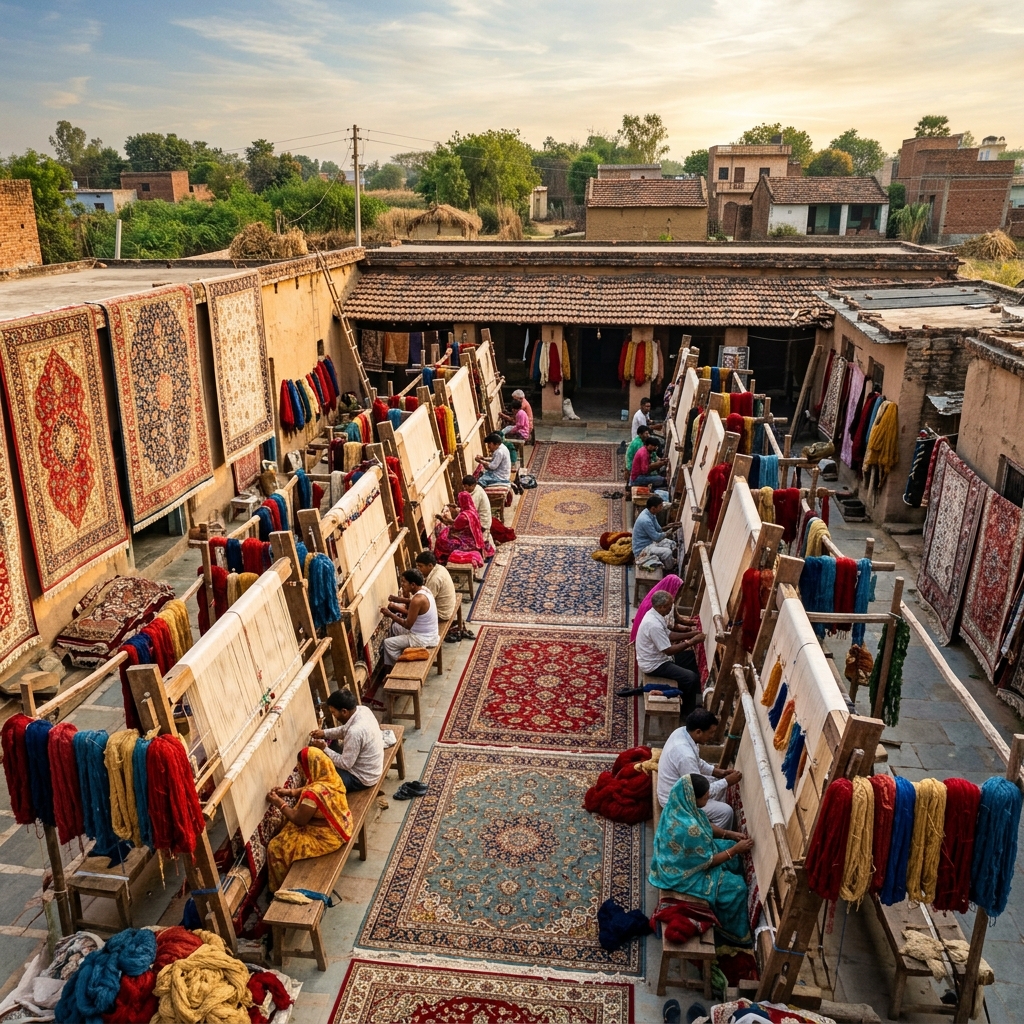
Bhadohi, a small town nestled in the Gangetic plains of Uttar Pradesh, is one of the most important centers of handmade carpet production in the entire world. Known as the "Carpet City" of India, Bhadohi and its surrounding villages have been producing exquisite handmade carpets for over 500 years. Today, the Bhadohi carpet belt employs more than 2.2 million people and exports carpets worth over $1.5 billion annually to more than 80 countries.
Mughal Origins: Where It All Began
The story of Bhadohi's carpet industry begins with the Mughal Empire. In the 16th century, Emperor Akbar — a great patron of arts and craftsmanship — invited master weavers from Persia to settle in India and establish carpet-weaving workshops. These Persian artisans brought their centuries-old weaving techniques, intricate design aesthetics, and the art of hand-knotting.
The Gangetic region around Bhadohi was chosen for several reasons. The climate was favorable — neither too hot nor too cold — ideal for working with wool and silk. The region had abundant access to raw materials: wool from Rajasthan, silk from Indian and Chinese sources, and cotton from the fertile plains. And the local population, already skilled in textile crafts, proved to be extraordinarily talented weavers.
Within a few generations, the weavers of Bhadohi had not only mastered Persian techniques but had begun to develop their own distinctive Indian carpet-making tradition — one that blended Persian precision with Indian color sensibility, Mughal floral motifs, and indigenous geometric patterns.
The British Era: From Local Craft to Global Trade
The carpet industry of Bhadohi received a tremendous boost during the British colonial period. In the mid-19th century, the East India Company recognized the exceptional quality of Bhadohi carpets and began exporting them to Europe, where they quickly became prized possessions of the wealthy.
The establishment of rail lines through the region in the 1870s further accelerated trade. By 1900, Bhadohi was the single largest center of handmade carpet production in Asia. European trading houses set up buying offices in the region, and Bhadohi carpets graced the floors of palaces, mansions, and government buildings across the British Empire.
The British period also saw the formal emergence of the "Mirzapur-Bhadohi carpet belt" — a 100-kilometer stretch that encompassed hundreds of weaving villages. This entire region became a UNESCO heritage zone for carpet making, with techniques and patterns passed down through families in unbroken chains spanning ten or more generations.
Post-Independence Boom
After Indian independence in 1947, the carpet industry of Bhadohi continued to thrive. The government established the Carpet Export Promotion Council (CEPC) in Bhadohi, making it the official hub for India's carpet export infrastructure. The Indian Institute of Carpet Technology was founded here to train the next generation of weavers and designers.
By the 1970s and 1980s, Bhadohi had emerged as the world's largest exporter of handmade carpets, surpassing even Iran and Turkey. The industry diversified from traditional Persian designs to include contemporary, modern, and transitional styles — making Bhadohi carpets appealing to a global audience with varied tastes.
The GI Tag: Protecting a Legacy
In 2010, Bhadohi hand-knotted carpets received the Geographical Indication (GI) tag from the Indian government — a recognition similar to Champagne for sparkling wine or Darjeeling for tea. This GI tag certifies that a carpet bearing the "Bhadohi" designation is authentically handmade in the Bhadohi region, using traditional techniques passed down through generations.
The GI tag protects consumers from counterfeits and machine-made imitations, and it protects the artisans' heritage. When you buy a GI-tagged Bhadohi carpet, you have the guarantee of authenticity.
The Art and Science of Bhadohi Weaving
What makes Bhadohi carpets special is the marriage of artistic design and meticulous craftsmanship:
Design Creation (Graph Paper Art): Before a single knot is tied, a master designer creates a detailed graph-paper pattern called a "naqsha." Each tiny square on the graph represents one knot, and the colored squares indicate which color yarn to use. A single carpet design may contain hundreds of thousands of colored squares — it's a full-scale blueprint.
Loom Setup: Traditional Bhadohi carpets are woven on vertical pit looms — large wooden frames where the warp (vertical) threads are strung under tension. The weaver sits on a plank in front of the loom and works from bottom to top, row by row.
Hand Knotting: The weaver ties each knot by hand, using short pieces of colored yarn. In a single day, a skilled weaver ties 8,000 to 12,000 knots. Each knot is cut to the precise length to match the desired pile height. The two main knot types used are the Turkish (Ghiordes) knot and the Persian (Senneh) knot.
Washing and Finishing: After weaving is complete, the carpet undergoes a multi-step washing process. In some families, traditional herbal washes using natural roots and tree bark are still used. The washing removes excess yarn residue, softens the pile, and brightens the colors. The carpet is then stretched, clipped to an even pile height, and dried in the sun.
Bhadohi Today: A Living Heritage
Today, the Bhadohi carpet belt encompasses over 2,500 villages across four districts of Uttar Pradesh. The industry has evolved while preserving its handmade traditions:
Modern Designs: While traditional Persian, Mughal, and Indo-Persian designs remain popular, Bhadohi now produces modern geometric, abstract, minimalist, and contemporary carpets that appeal to Western and urban markets.
New Materials: In addition to traditional wool and silk, Bhadohi weavers now work with bamboo silk, Tencel, recycled PET fiber, and other sustainable materials — meeting global demand for eco-friendly products.
Technology Integration: Modern dye chemistry ensures colorfastness and consistency. Computer-aided design (CAD) allows faster prototyping of new patterns. Yet the weaving itself remains firmly in human hands.
Social Impact: The carpet industry is the economic backbone of the Bhadohi region. Organizations like Goodweave work with manufacturers to ensure fair wages, safe working conditions, and zero child labor — important commitments for the modern industry.
AJAYPEE CARPETS's Bhadohi Story
Founded in 1987 in Jalalpur, Bhadohi, AJAYPEE CARPETS was born from this rich heritage. Our founder, Anwar Ahmad, grew up surrounded by looms, patterns, and the rhythmic clacking of weavers at work. Today, we work with over 200 master artisans from the Bhadohi region, producing luxury handmade carpets that are exported to more than 40 countries.
Every carpet that leaves our workshop carries within it over 500 years of tradition, the skill of generations of artisans, and the enduring spirit of Bhadohi — the carpet capital of the world.
Visiting Bhadohi
If you're passionate about carpets, a visit to Bhadohi is a must. Visitors can tour active weaving workshops, watch master artisans at work, see traditional washing and finishing processes, and even commission custom designs. The Carpet Expo held annually in Varanasi (just 30 km from Bhadohi) is another excellent opportunity to explore the region's carpet heritage.
AJAYPEE CARPETS welcomes visitors to our Bhadohi workshop by appointment. Contact us to arrange a visit and experience the magic of handmade carpet creation firsthand.
Published in Industry News